
As we mark Youth Employment Week, it's an opportunity to reflect on the role education plays in helping every young person develop the skills, confidence and aspirations they need for their future.
For children in care and learners supported by a social worker, the journey towards employment and adulthood is often shaped by additional challenges.
The government guidance, How schools and colleges support the academic and personal progress of children in care, highlights the importance of high aspirations, personalised support and positive relationships in the preparation to adulthood. These priorities closely align with ASDAN’s commitment to equipping learners with practical skills and meaningful learning experiences that help them get to where they want to go.
Our Moving On programme gives young people aged 16+ the knowledge, skills and confidence to transition into independent living. The course responds to the real needs of young people preparing to live on their own for the first time, including those leaving care, and provides practical, learner-centred activities that can be adapted to individual needs across a range of education and care settings.
Enabling successful transitions through personalised learning
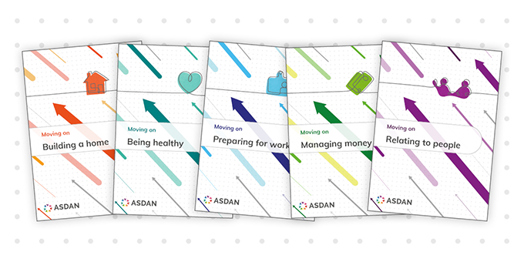
Moving On supports learners to build independence through five ‘pick and mix’-style journals. Each journal is aligned with key areas of care leaver pathway plans: Building a home, Being healthy, Starting your career, Managing money and Relating to people.
Learners can choose to complete the modules that are relevant and meaningful to them. Through bite-sized, real-world activities, learners can develop at their own pace while practitioners tailor learning around individual strengths, interests and support needs.
These portable journals support transitions between professionals, while providing valuable evidence of a learner's progress and helping demonstrate when they are ready to move on.
This practical, personalised approach has been embraced by professionals supporting care leavers. Anne-Marie Francies, Service Manager at Barnet's Onwards and Upwards, said:
"We see Moving On as an integral part of a young person's journey that you wouldn't want to move on without having access to."
She also highlights the value of the programme’s hands-on approach, explaining that “practical learning is always a winner” because it helps young people develop the confidence and life skills they need beyond education.
The flexibility of the programme also reflects the government’s emphasis on personalised support. As Kirsty Carmichael, Learning Coordinator at Blue Mountain Homes explains:
"The adaptability means that one piece of work can be delivered to any level, and that's so important to reach young people in care."

Building confidence through trusted relationships and improving attendance
The second government guidance piece we’d like to focus on, Social workers and other practitioners: attendance considerations, recognises that attendance is closely linked to wellbeing, relationships and wider life circumstances. It highlights the importance of relationship-based, multi-agency approaches that build trust, stability and engagement.
Moving On encourages learners to explore education, employment and training opportunities, while modules covering wellbeing, identity and relationships help develop the personal and social skills that underpin successful transitions into adulthood.
The programme is designed to be delivered alongside a trusted adult, creating opportunities for meaningful conversations, shared reflection and collaborative goal setting. This ensures learning complements wider support plans developed by schools, carers, social workers and other professionals.
Jamie Diwell, Education Manager at Wilderness Way and ASDAN Trustee, has seen first-hand the difference this approach can make for young people preparing to leave care:
"Moving On has given our care leavers confidence and the tools to build the stairs to get to where they want to be. Moving On really broadens young people's horizons. It gives them control over their future."
Jamie recalls supporting one young woman who had previously experienced exploitation while living semi-independently and was understandably anxious about moving into college accommodation. Working through the Building a Home journal helped her understand tenancy agreements, recognise where to access support and rebuild her confidence.
Reflecting on her progress, Jamie said:
"Working through the Building a Home module helped her work through the trauma she experienced, and it gave her the help she needed to make sure it didn't happen again. She recently contacted us to say that she'd reached for the Moving On journal and contacted the helpline given. It's really nice to know that Moving On is being used after they leave us."

Helping every young person move forward
The attendance guidance recognises that improving engagement requires flexible, personalised approaches built on trust. For learners who have experienced disrupted education, practical learning can help rebuild confidence, strengthen resilience and support re-engagement.
Moving On supports this by developing practical life skills for independent living, helping young people establish routines, raise aspirations and prepare for employment. Its flexible delivery supports joined-up working across education and care settings.
Whether the goal is improving attendance, preparing for employment or building independence, Moving On aligns with government priorities by providing practical skills, personalised support and trusted relationships.
As Kirsty Carmichael of Blue Mountain Homes summarises:
"I would absolutely recommend that other settings deliver Moving On as part of their curriculum. You will really see the difference it makes. It gives young people the best possible tools to move forward and start to take control of their own future."
Find out more about Moving On and get in touch with our team to speak about how the programme can help your young people.