 Blog
Blog
20/05/2026
Climate anxiety and the green skills gap: an interview with Liz Newbon on ASDAN’s Environmental Short Course
When educators talk about sustainability in schools, the focus is often on what learners need to know about climate change. For Liz Newbon, the bigger question is how education can empower learners to shape a fairer, more sustainable world.
Education consultant and former teacher Liz Newbon has developed resources for a wide range of organisations and co-authored ASDAN’s Environmental Short Course to build environmental knowledge alongside confidence, agency and practical skills through flexible, learner-centred approaches.
“What really drew me to ASDAN was that learner-centred, skills-based approach,” says Liz. “It shifts the focus onto practical, adaptable learning rather than more traditional models.”
Moving from awareness to action
Liz emphasised the importance of giving learners opportunities to actively engage with climate issues, rather than simply learning about them in theory.
“Many young people benefit from a learn, think, act approach,” she says. “It’s about helping them learn about an issue, think critically about it and understand the role they want to play, while also giving them agency to take action.”
Rather than treating sustainability as an “add-on” to the curriculum, Liz sees it as something that should run across education more widely.
“I think climate change and sustainability should be seen as a lens across the curriculum,” she explains. “It links to communication skills, decision-making, teamwork and self-awareness – all those transferable skills young people need.”
For Liz, that practical and applied focus is one of the key differences between ASDAN’s approach and more traditional models of environmental education.
“There’s definitely still a place for knowledge-rich learning,” she says. “But ASDAN’s Environmental Short Course is much more about inquiry, skills and applying learning in real life so learners can see how what they’re learning connects to their own lives and communities.”
Responding to climate anxiety
A major theme throughout the conversation was climate anxiety and the emotional impact of environmental issues.
“There’s research showing climate anxiety rates are increasing amongst young people,” says Liz. “For many learners, climate change is affecting their daily lives and how they feel about the future.”
“If learners only hear about the problems, it can feel overwhelming,” she explains. “Action helps bridge the gap between knowledge and hope.”
Liz emphasises that climate action does not have to mean huge gestures.
“One of the most impactful things we can do about climate change is talk to other people about it,” she says. “That sounds simple, but it’s actually really effective, both in terms of climate action and skills development.”
She also highlights the importance of helping learners develop relationships with nature.
“Developing meaningful connections with nature is really important,” Liz explains. “That connection can support wellbeing, confidence and engagement, especially when young people are feeling anxious about environmental issues.”
At the same time, she believes learners need opportunities to understand the bigger picture around climate justice and collective change.
“Sometimes people can feel powerless,” she says. “But individual actions do help drive wider system changes, and those wider system changes are also necessary to support individual action.”
Building green skills for the future
Alongside environmental knowledge, ASDAN’s Environmental Short Course places strong emphasis on developing transferable skills, which Liz sees as increasingly important in the context of the growing “green skills gap”.
“The skills we need to tackle climate change are changing rapidly,” she says. “Young people need not only technical knowledge, but also adaptability, resilience, empathy, collaboration and influencing skills.”
While green skills are often associated with future jobs in science or engineering, Liz believes the conversation should be broader.
“There are green life skills too,” she explains. “Things like adaptability, empathy and working with others. Those are skills young people need not just for future careers, but for life more generally.”
For Liz, ASDAN’s skills-based approach is valuable because it focuses on helping learners apply their knowledge in practical and meaningful ways.
“It’s about helping learners see how they can use their knowledge and skills to create change in their own communities and in the wider world.”
Flexibility and learner ownership through Equitas
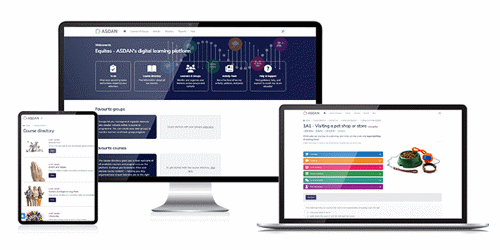
The Environmental Short Course is now available on ASDAN’s digital platform, Equitas, which allows learners to build digital portfolios and present evidence in different ways.
“It gives learners a sense of ownership in terms of the pathway they want to take through the course, but also ownership over how they present their achievements,” she says.
Learners can submit evidence in ways that suit their strengths and preferred ways of working, whether through written, verbal, visual or digital formats.
“If learners are told straight away that they have to present evidence in one specific way, that can immediately become a barrier,” Liz explains. “Having that flexible approach is really key in terms of engagement and motivation.”
Why inclusive sustainability education matters 
Liz points out that learners with SEND and those in alternative provision can face some of the biggest barriers in education, while also standing to gain enormously from opportunities to engage with sustainability and environmental action.
“Those learners often have the most to gain, whether that’s deepening connections with nature, building green skills or simply having a voice in shaping the world they want to see.”
“You can’t see climate change as an issue on its own,” she says. “It’s very much interconnected with social challenges.”
“Sustainability education and action need whole-sector, whole-society efforts,” Liz says. “That means making sure the tools, resources and systems we use are inclusive and meet the needs of all learners.”
Ultimately, Liz hopes the course helps learners feel empowered rather than overwhelmed.
“It’s about putting learners at the centre of their learning,” she says, “and helping them see that they can be part of creating a more sustainable world.”
Would you like to deliver ASDAN?
We'd love to hear from you. Please fill out this short form and one of our curriculum experts will be in touch to discuss the best fit for you and your learners.