 Blog
Blog
08/10/2026
Employability Skills Framework: what it means for ASDAN schools and colleges
A new shared language for employability skills
Skills England published its Employability Skills Framework on 5 October 2026. It brings together established frameworks and standards, creating a shared language across education, training and work. The 13 skills are:
- Planning and organising
- Adapting
- Working with others
- Listening
- Speaking
- Leadership
- Learning and investigating
- Creating
- Problem solving and decision making
- Numeracy
- Digital literacy
- Reading
- Writing
The framework is direct about the problem it solves. It states that young people and employers ‘often struggle to recognise the same employability skills in each other’.
Our work is designed to help close that gap.
Why having skills is not enough
A learner can have a skill without being able to prove it. The framework is as much about recognition as it is about skill-building.
Employers need evidence they can trust, and learners need the confidence to talk about their skills. That matters even more for learners who have had fewer chances to learn through real-world experiences. ASDAN courses are designed to provide learners, at different starting points, with equitable access to meaningful, practical learning experiences.
Every ASDAN course uses a plan, do, review cycle. Learners plan an activity, carry it out, then reflect on what they can now do. This builds the evidence and language the new framework calls for.
How our six core skills align with the framework
Our six core skills sit at the heart of every ASDAN course: learning, communicating, decision making, thinking, team working and self-awareness. They align closely with the skills recognised in the new framework.
Skills England is clear that the framework does not replace existing ones. It is designed to work alongside established frameworks, including the Skills Builder Universal Framework.
ASDAN partners with Skills Builder Partnership UK, aligning our six core skills with theirs. Schools can combine our accredited qualifications with Skills Builder's fully funded Accelerator programme to embed these skills school-wide.
Educators can connect their current skills work to a common language, rather than start again. The framework also reflects how work is changing, including digital literacy and the responsible use of AI.
Placements with purpose: evidence beyond the classroom
ASDAN's placements with purpose curriculum map (PDF) shows an example of this journey in practice, from Year 7 to Year 11, with routes tailored to individual needs. You can use it as a starting point and adapt it to fit your context, setting and learners.
The Careers & Enterprise Company's equalex framework promotes meaningful, multiple and equitable experiences of workplaces, with structured, progressive learning outcomes. Our placements with purpose approach helps you connect those experiences to a longer curriculum journey, rather than treating work experience as an isolated event. It also supports the Gatsby Benchmarks on employer encounters and workplace experiences.
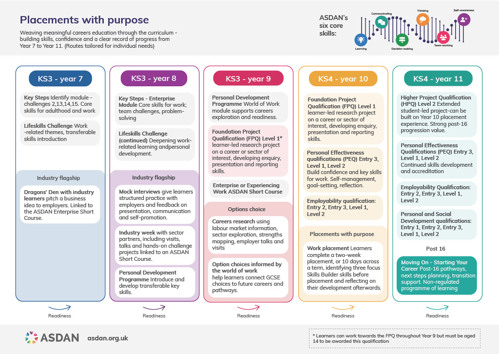
A key part of this journey is the Year 10 work placement. Learners complete two weeks, or 10 days across a term. They identify three focus skills before they start, then reflect on their development once it ends.
The placement sits within a wider programme. In Year 7, learners build core skills for work through Key Steps and Lifeskills Challenge. Industry flagship activities bring this to life early, from a Dragons' Den pitch to real employers in Year 7, to mock interviews and an employer-led industry week in Year 8.
By Year 9, learners can start researching for the Foundation Project Qualification (FPQ) Level 1, exploring a career or sector of their choice. They must be 14 before they can be awarded the qualification. Year 10 then introduces the Employability and Personal Effectiveness Qualifications (PEQ), alongside the work placement itself.
Year 11 builds further with the Higher Project Qualification (HPQ) Level 2, continued PEQ and Employability study, and Personal and Social Development qualifications. Moving On then supports the transition to post-16 pathways.
Learners who want to go further can base an independent project on their placement or a vocational interest through the Extended Project Qualification (EPQ).
Every stage builds toward the same outcome: a young person who can show what they can do. Whatever your context, every learner can plan, do, review and leave with evidence that parents, carers, educators and employers can understand.
From ASDAN's Chief Executive
ASDAN's Chief Executive Melissa Farnham welcomes the framework: "Through purposeful projects, challenges, qualifications and real-world experiences, we can give young people opportunities to develop these skills, but critically, also to build the evidence, language and confidence to say: 'I know what I can do. I can show you where I have done it, and I can explain how I can use it somewhere else.' For me, that is real agency."
She added that this work "feels closely aligned with the work we are doing at ASDAN to engage, elevate and empower every learner at any starting point."
Explore this with your learners
We help learners develop, recognise and evidence employability skills through meaningful, real-world learning. Explore our Project Qualifications, Personal Effectiveness Qualifications and Employability qualifications to see how.
Every ASDAN membership starts with a curriculum consultation. Get in touch about membership to talk through what this could look like for your learners.